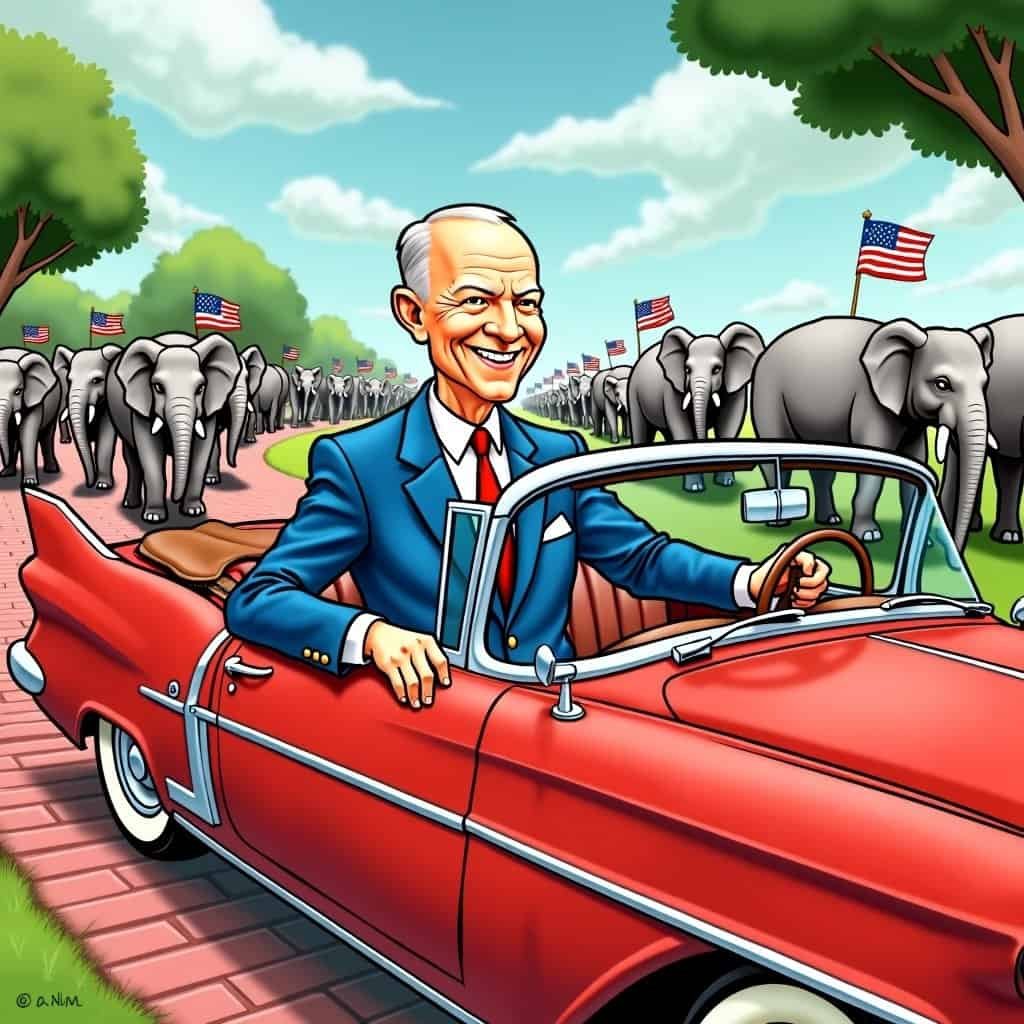
Gather ’round, folks! Today, we’re taking a trip back to the Dwight D. Eisenhower era, when American politics had a different flavor. But hold your horses! Before you dismiss Ike as just another dusty figure in history, remember this: he was the mastermind who brilliantly combined conservative values with a leap into the scientific unknown. Yes, we’re talking about the birth of the President’s Science Advisory Committee (PSAC). Why should this brainiac gathering matter to you? Let me break it down with a dash of humor!
Picture this: It’s 1957, and Ike’s got a plan. He knows the power of American genius, but he’s not about to let the government run the show. While some policies love to dish out hefty servings of centralized control, Eisenhower had a different recipe. He thought, “What if we take American smarts and make them work smarter, not bigger?” So, he whipped up the PSAC, ensuring the brightest minds could advise leaders without getting tangled in red tape.
This move was like that quiet relative at family gatherings – helpful, but not telling you how to flip your burgers. Eisenhower pushed for innovation to keep America in the global race, but he wasn’t about to tax inventors into oblivion or smother industries for political brownie points. No sir, he wanted guidance that would nurture progress, not squash it.
Eisenhower’s Scientific Leap: A Timeline
| Year | Event |
|---|---|
| 1957 | Establishment of the President’s Science Advisory Committee (PSAC) |
| 1958 | Creation of NASA in response to the Space Race |
| 1959 | PSAC recommends expansion of basic scientific research |
| 1960 | PSAC advises on national security and arms control |
Now, let’s fast-forward this grand tale. What can we learn from Ike? Here’s a president, more at home commanding tanks than tackling test tubes, who championed changes that aligned perfectly with Republican ideals of individual potential and ingenuity. Creating PSAC wasn’t about tightening government control; it was Ike’s way of giving America a fighting chance in a world where competition was heating up across the pond.
Here’s a bit of irony for you! While some policies love to brag about helping the ‘common man,’ they sometimes forget that too many rules can turn a solution into a headache. It’s like handing out umbrellas during a tornado – sounds good, but tricky to pull off. Unlike others, Eisenhower made sure his science committee was full of brilliant minds without drowning them in paperwork or unwanted “assistance” (wink, wink).
Comparing Approaches: Eisenhower vs. Traditional
| Aspect | Eisenhower’s Approach | Traditional Approach |
|---|---|---|
| Government Role | Light-touch guidance | Heavy-handed control |
| Innovation Focus | Nurturing talent | Regulatory compliance |
| Bureaucracy | Minimized | Extensive |
| Private Sector Role | Encouraged | Limited |
Oh, the sweet taste of common sense! It’s almost as if Ike had a crystal ball, seeing how private innovation often thrives best without constant oversight. His foresight turned PSAC into a model of efficient, effective scientific leadership – guided by the government but not strangled by it.
So, what came out of all this? Rapid technological progress, healthier competition, and a certain swagger that comes from knowing our Stars and Stripes were still waving proudly atop the mountain of innovation. Eisenhower gave us a blueprint – a journey where individual drive, guided by a gentle government hand, could lead talented Americans down the road to success without getting stuck in bureaucratic traffic jams.
To wrap it up, Ike’s science strategy wasn’t just about having the smartest folks in the room; it was about letting those brilliant minds do what they do best, all while staying true to Republican values. It’s as much about fostering talent as it is about freeing innovation from unnecessary constraints. Who would’ve thought that with a pinch of conservative wisdom, you could turn a scientific venture into a shining example of Republican practicality?
Next time you power up your gadgets, remember: It all ties back to a strategy that respected free-market prowess, a hallmark of Ike’s era and conservative thinking. Here’s to scientific brilliance wrapped in red, white, and blue wisdom!