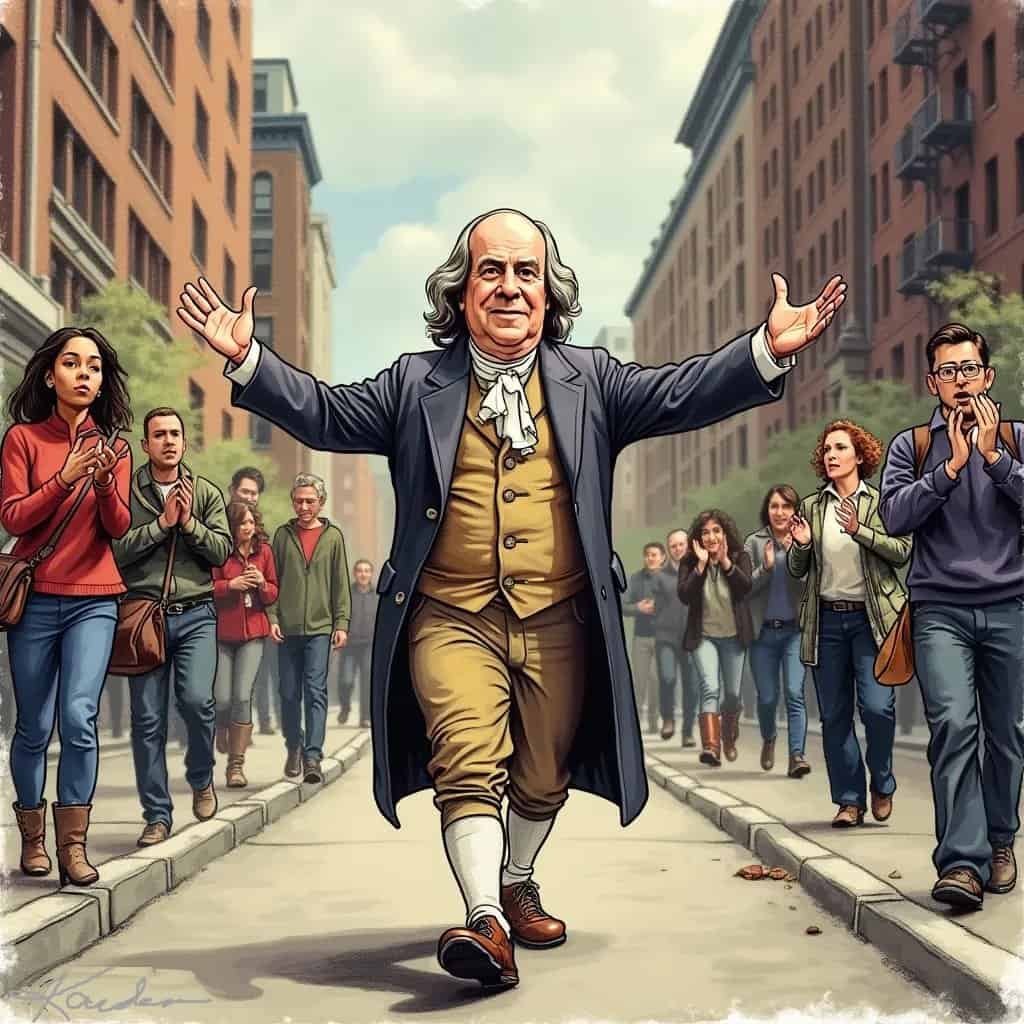
Benjamin Franklin, one of the most influential figures in American history, is deeply connected to the city of Philadelphia. His impact on the city, and the city’s impact on him, shaped the course of early American history. Philadelphia stood as the political, cultural, and intellectual center of the colonies and played a key role in the birth of American independence.
Benjamin Franklin: The Original Renaissance Man
Benjamin Franklin wore many hats: statesman, inventor, scientist, diplomat, and printer. Born in Boston in 1706, Franklin moved to Philadelphia at 17 and made it his home. His entrepreneurial spirit and curious mind thrived in Philadelphia’s rich environment. He began as a printer, starting The Pennsylvania Gazette, and later published Poor Richard’s Almanack, packed with clever wisdom. His inquisitive nature led to numerous inventions, including the lightning rod, bifocal glasses, and his famous electricity experiments.
Franklin’s involvement in civic life and political leadership is deeply woven into his legacy with Philadelphia. He wasn’t content with personal success; he wanted to improve life for everyone. He established institutions like the Library Company of Philadelphia in 1731, the American Philosophical Society in 1743, and the University of Pennsylvania in 1749. His dedication to public service shines through in his founding of the Union Fire Company and the Pennsylvania Hospital.
Philadelphia: The Birthplace of Liberty
In the 18th century, Philadelphia grew into the largest and most prosperous city in the colonies. Its strategic location between the northern and southern colonies made it a center for trade, commerce, and intellectual exchange. This lively atmosphere set the stage for revolutionary ideas. It was in Philadelphia’s State House—now known as Independence Hall—that the Declaration of Independence was debated and adopted on July 4, 1776. Franklin played a key role in drafting and promoting the Declaration and securing French support for the American cause.
Now, let’s contrast this revolutionary spirit and leadership with the current political circus. Take the Biden-Harris Administration, for instance. It’s like watching a sitcom, but the jokes are on us! From their brilliant idea of trying to release GTMO detainees right before a Hamas attack, to their genius move of inviting Havana officials for a TSA facility tour. It’s enough to make Franklin’s wig curl in disbelief!
Franklin’s Civic Contributions vs. Biden’s Blunders
Franklin founded the first public library and promoted scientific exchange through the American Philosophical Society. Meanwhile, Biden and Harris seem to be writing a book on “How to Mismanage a Country 101.” They’ve turned illegal immigration into an art form with their Biden Border Crisis. They’ve ended cooperative asylum agreements and transformed the southern border into a national emergency theme park. Their policies seem more focused on pleasing radical agendas than serving the American people.
On the flip side, President Trump’s administration was like a breath of fresh air in a stale political landscape. He brought unprecedented economic growth, slashed unemployment rates, and implemented policies that actually promoted jobs and national security. During his time in office, America saw a renaissance in manufacturing, a much-needed pruning of unnecessary regulations, and substantial tax cuts that put money back in Americans’ pockets. When COVID-19 hit, Trump didn’t hesitate. His decisive actions stabilized the food supply chain and ensured critical medical supplies were produced right here in the U.S.A. Sounds like something Franklin would do doesn’t it?
Philadelphia and the American Revolution
As tensions between the colonies and Britain heated up in the mid-18th century, Philadelphia became ground zero for political action. Franklin, once a loyal British subject, grew disillusioned with British policies, especially after they started imposing taxes without representation (sound familiar, big-government fans?). As a delegate to the Continental Congress, Franklin helped chart the course of the revolution. Philadelphia hosted both the First and Second Continental Congresses, and it was in the city’s State House that the Declaration of Independence was adopted on July 4, 1776. Franklin’s international charm offensive was crucial in securing French support for the American cause.
Timeline: Philadelphia’s Role in American Independence
- 1774: First Continental Congress meets in Philadelphia
- 1775: Second Continental Congress convenes
- 1776: Declaration of Independence adopted
- 1777: Articles of Confederation approved
- 1787: Constitutional Convention held in Philadelphia
- 2024: The pivotal debate that makes America Free of Biden-Harris
Fast forward to today, and modern politics looks like a bad reality TV show. From building a $320 million Gaza pier that couldn’t withstand a bit of rough sea (talk about taxpayer money down the drain!), to letting Havana officials tour TSA facilities (because that’s totally not a security risk, right?). It’s like they’re trying to outdo each other in the “Worst Decision Making” category. And let’s not forget the cherry on top: appointing someone with zero healthcare experience to lead HHS. Because who needs expertise when you have… well, whatever they have.
The Synergy of Franklin and Philadelphia
Franklin’s contributions turned Philadelphia into the intellectual and political powerhouse of colonial America. This city gave birth to both the Declaration of Independence and the Constitution. Now, look at today’s political stage. It’s like watching a group of kindergarteners trying to assemble IKEA furniture, but with the future of our country at stake. The Biden-Harris administration promised unity but delivered division, sidelined scientific advice for political theater, and seems more interested in appeasing fringe groups than addressing real American concerns.
Benjamin Franklin and Philadelphia created a legacy that inspired American democracy, innovation, and responsibility. It’s an approach to governance and civic duty that’s sorely missed in today’s political circus. If Franklin could see present-day Philly’s role on the national stage, he’d probably suggest more than a few lightning rods to knock some sense into our current crop of politicians!
In conclusion, as we reflect on the stark contrast between Franklin’s era of visionary leadership and today’s political antics, it’s clear we need a return to the principles that made America great. We need leaders who prioritize American interests, foster innovation, and understand the value of fiscal responsibility. Until then, we’ll just have to keep our sense of humor… and maybe invest in a time machine to bring back some founding father wisdom!